

01
The finger as brush以指代笔
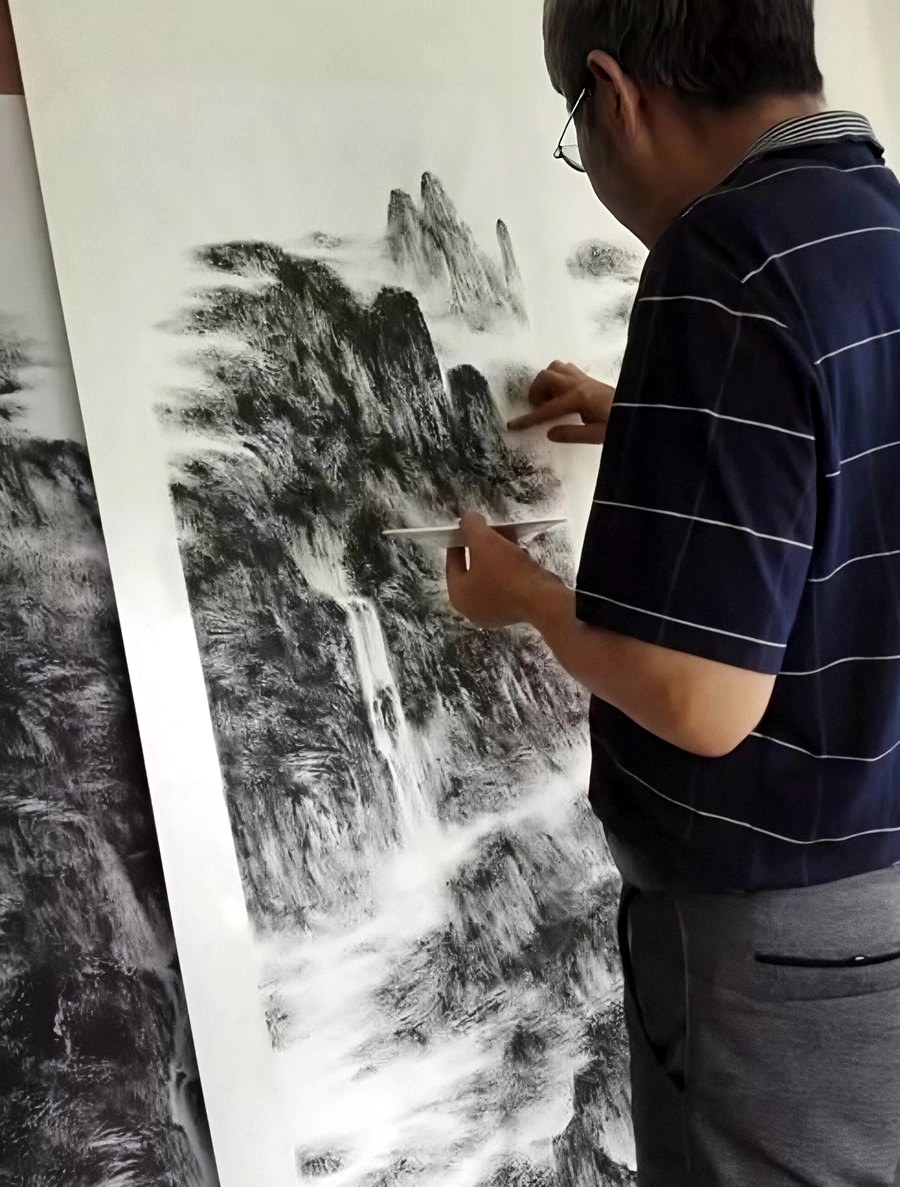
Burnt ink is already hard to control; removing the brush leaves only fingertip and paper. Nail-edge lines cut sharp, the pad lays down mottled texture — qualities a brush can barely reproduce.
焦墨本就难控,再去掉毛笔,只留指尖与纸面相触。指甲勾线见锐利,指腹擦染得浑厚——这是毛笔很难复刻的质感。
 方聿真
Formal language形式语言研究
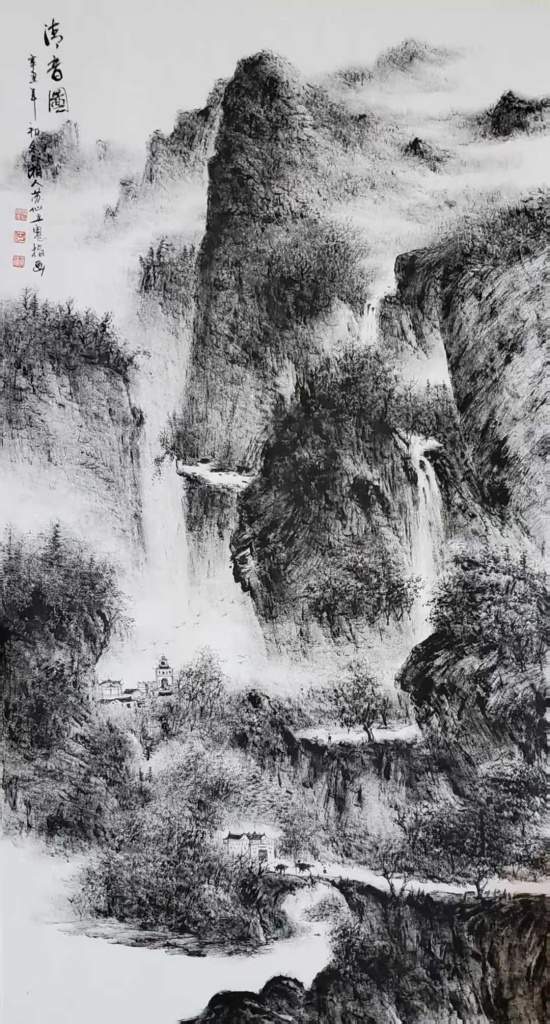
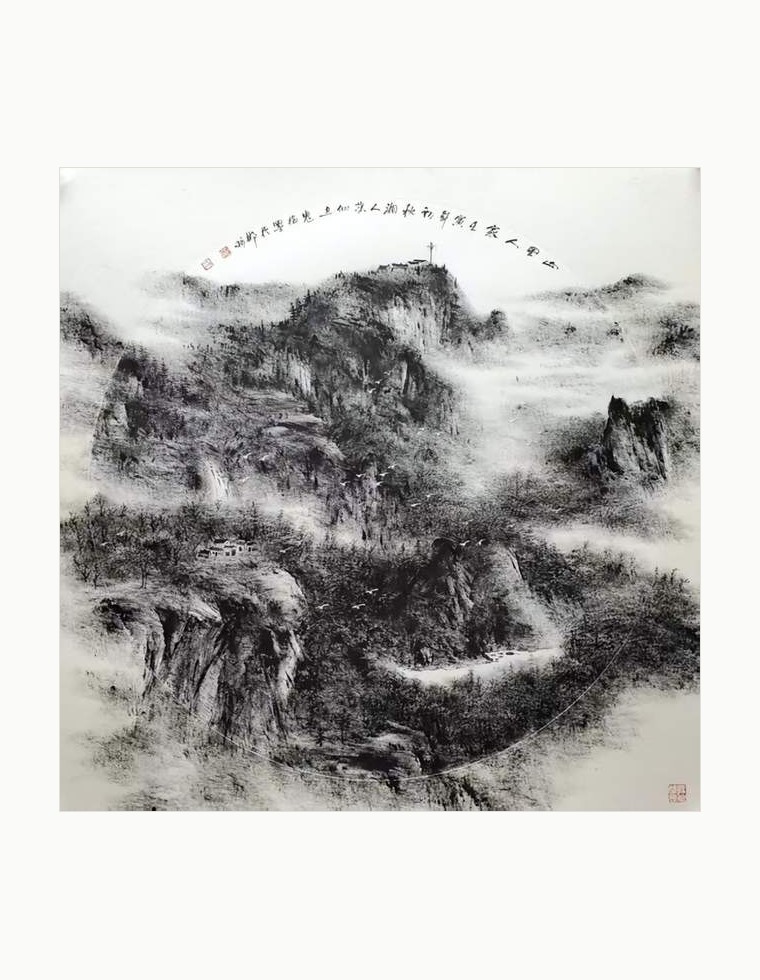
Remove the brush and the cushion of hair between hand and paper goes with it. What remains is a directness that a brush can only approximate: the sharp, incised line of a fingernail; the granular, broken texture left by the pad of a finger. Each mark is made once — burnt ink allows almost no revision, so the painting must be fully resolved in the mind before the hand touches the paper. He has never treated this as a curiosity. It is a complete landscape language, in which ridges, forest and drifting cloud all arrive through the fingertips. 以指代笔,突破毛笔工具的固有边界,是何珍泉艺术创作最为鲜明的标识。焦墨本身属于绘画之中难度极高的表达路径,墨色枯燥,少有水墨晕染的便利,对创作者的把控力提出严苛考验,而何珍泉更进一步,将手指与焦墨二者相融,开辟出手指焦墨山水的创作道路。手指没有笔毫的缓冲,落笔痕迹直接而真切,指甲勾勒的劲利线条、指腹皴擦出的斑驳肌理,都是毛笔很难复刻的质感。作画之时落墨即成,几乎没有修改余地,要求画家构思完整、心手高度合一。何珍泉没有将指墨仅仅当作猎奇的技艺噱头,而是把它转化成完整成熟的山水艺术语言。他依托这套独特技法去表现山川丘壑,山石的嶙峋、林木的苍莽、云雾的流转,都经由指尖落在纸面。在当代山水画多元发展的格局之下,何珍泉用工具的革新带动审美表达的拓展,让古老的指画与焦墨传统,生长出属于这个时代的全新面貌。
02
Inheritance, not imitation师承与蜕变
He learned from Zhang Ding the spirit — painting from nature, dry yet moist — not the surface. Inheritance means taking the spirit, not copying the shape.
他追随张仃研习焦墨,学的是「面向自然、燥中见润」的精神,而非画面样貌。传承的意义在于取其精神,而非描摹外形。
 付尧
Lineage文脉考辨
He studied under Zhang Ding, absorbing the master's insistence on drawing from nature rather than from pattern books, on a quality that is dry yet moist, on structure with bone in it. What he did not take was the instrument. Zhang Ding's mass and gravity survive in his work; what is new is the rawness — the plainness and slight awkwardness that comes when a finger, not a brush, is asked to carry a mountain. Inheritance, in this reading, means taking the spirit and leaving the surface alone. 师承是艺术传承的重要纽带,但真正的继承绝非简单复制老师的画面样貌。何珍泉追随张仃先生研习焦墨艺术,深刻领会先生焦墨山水的精神内核,又走出属于自我的创作道路。张仃先生毕生深耕焦墨领域,主张面向自然写生,拒绝固守古人画谱程式,追求燥中见润、骨力充盈的画面气质,这份创作理念深深影响着何珍泉的艺术认知。何珍泉吸收师长重视写生、尊重客观山川的创作思想,却没有沿用毛笔焦墨的既有范式,大胆引入指画的表现方式。他保留焦墨追求质朴黑白力量的内核,改换表达媒介,用指尖重新诠释焦墨山水的风骨。可以看到,他的作品之中延续着雄强苍厚的格局,山石结构讲究扎实稳重,同时又因手指作画带来生拙、朴野的独特质感。这份传承与蜕变启示我们,师承的意义在于取其精神,而非描摹外形。
03
Colourless, therefore abundant素以为绚
Giving up colour is not a reduction but a focusing. Dry and wet, dense and sparse, nail and pad and palm: from these alone he builds distance and weight.
舍弃色彩不是缩减,而是向内聚焦。单凭墨色的枯湿浓淡,指甲、指腹、掌侧的交替,仍能写出群山的层次远近。
 林宁
Aesthetics美学批评
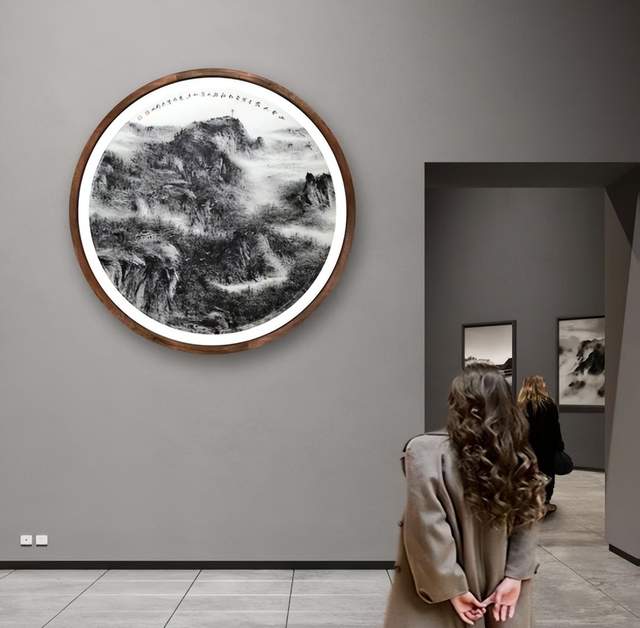
Burnt ink forbids colour and rewards control. Its depth is not in pigment but in the dryness of a line, the density of a rubbing, the amount of white left standing inside a stroke. A fingernail scores; the pad smears and softens; where nail meets flesh the ink breaks into a mottled fly-white. With no colour at all, he still builds distance and nearness, weight and air. To give up colour is not to reduce the painting but to focus it — everything is pushed into form, structure and breath. 中国画的黑白之美,在焦墨创作当中被推向极致,摒弃绚烂色彩,单凭墨色的枯湿浓淡构建完整的山水世界。很多观者会误以为焦墨只有单调漆黑,实则焦墨的层次蕴藏在线条的虚实、皴擦的疏密、飞白的多少之间,考验画家对墨质与纸张的深度理解。何珍泉依靠手指不同部位,在宣纸上制造丰富变化,指甲勾线见锐利,指腹擦染得浑厚,甲肉相接处生出斑驳飞白,不用丹青敷色,依旧能够表现群山的层次远近。舍弃色彩,并不是艺术表达的缩减,反而是向内聚焦,将全部力量倾注于形体、骨架与气韵。何珍泉的画面剥去外在华丽装饰,直面山水本体精神,山石的雄峻、山林的荒寂悠远,全部依托黑白关系铺展。在色彩泛滥的当代画坛,这种坚守黑白本体的创作,让观者重新体会笔墨本身直击心灵的感染力。
04
Rooted in the land根在山水
The peaks and ravines of southern China supply the material. He does not copy them; he carries them inward and releases them through the fingertips.
南国的峰峦溪谷是他源源不断的素材。他不复刻景物,而是游历之后把山川内化于心,再经由指尖落于纸上。
 顾枕山
Cultural reading文化阐释
Technique without terrain becomes a pile of empty signs. The peaks and ravines of southern China — the woods, the drifting mist over the fields — supply him with material he does not copy but carries inward, releasing it later through the fingertips. Because the hand touches the paper directly, mood transfers without mediation: before a cliff the line turns hard and abrupt; in a quiet valley the rubbing slackens and slows. Each mark keeps the record of a conversation with a real place. 山水绘画的根基永远是现实自然,再好的技法,如果脱离对山川大地的体察,终究会沦为空洞的符号堆砌。南国的峰峦溪谷,乡野间的林莽烟云,给他源源不断的创作素材。他并非对景物做机械复刻,而是游历观察之后,把山川印象内化于心,再经由指尖将胸中丘壑付诸纸上。手指作画,手与纸张直接接触,身体感受和画面创作无缝衔接,画家内心情绪可以更直接地传递给作品。当面对雄奇险峻的山景,指下线条便趋于刚硬顿挫;表现幽谧山谷云雾,皴擦又变得舒缓松弛。何珍泉把游历山川获得的感动,转化为指下的痕迹,每一道指痕都带着创作者与自然对话的印记。工具的创新只是外在形式,艺术的内核依旧是心与物的交融。
05
Raising the ceiling破局
Finger painting was long treated as a minor art, unable to carry a full landscape. He built a grammar of fingertip, nail and palm — a path “born of the brush, yet apart from it”.
指画历来被视为旁门小技,难成大幅山水。他以指法组合弥补工具短板,走出「出于笔,迥于笔」的路径。
 陆振邦
Art history史论研究
Finger painting has a long history and a low ceiling. It was long treated as a minor pursuit — suited to small lyrical pieces, unable to carry a full landscape. He set out to change that. A finger holds far less ink than a brush, so long sustained strokes and broad rubbings must be built from many smaller gestures: fingertip, nail, pad and the side of the palm, deploying dot, hook, texture-stroke and wash in combination. Innovation here is not novelty; it is finding possibility inside constraint. Rather than imitate the smoothness of a brush, he amplifies what only a finger can do — a path “born of the brush, yet apart from it”. 在中国绘画史中,指画古已有之,历代不乏尝试者,但长久以来大多被视作笔墨之外的旁门小技,很难构建宏大完整的山水体系。多数传统指画多偏向小品抒情,受限于工具,很难驾驭大幅全景山水,而何珍泉致力于把手指焦墨发展成独立完备的山水画门类。这一条创新道路充满阻碍:手指蓄墨量远不及毛笔,难以做绵长持续的运笔,山石的大面积皴擦、连绵不断的长线条都要克服先天工具短板。何珍泉经过大量反复实践,摸索一套适配手指焦墨的构图与指法,灵活调配指尖、指甲、指腹乃至掌侧,组合运用点、勾、皴、擦各类手法。创新不是凭空猎奇,而是在局限之中寻找可能性。他正视指墨工具的短板,顺势发挥其生辣朴拙的长处,不刻意模仿毛笔绘画的温润效果,主动放大手指触纸独有的肌理趣味,走出「出于笔,迥于笔」的创作路径,为传统指画的现代转型提供重要实践样本。
06
The hand, left in the work人画合一
A brush filters something out of the hand. A finger does not. Every hesitation and tremor stays on the paper — and that plainness is the point.
毛笔会过滤掉一部分情绪,手指不会。每一处顿挫、抖动、轻重都被如实留存——这份朴拙正是作品的特质。
 魏崇越
Close reading作品品鉴
A brush filters something out of the hand; a finger does not. Every hesitation, every tremor, every shift of pressure stays on the paper, and with it a plainness that is not refined away. Read the surface and the different fingers are legible: a hard nail cutting the edge of a rock, a soft pad laying in the volume of a slope, an accidental fly-white recording the exact force of a single moment. He does not polish the painting smooth. The coarseness is the point — it is where the person is. 绘画不止描绘客观景物,更是画家个人性情、气质的外化。毛笔作画,笔毫充当手和纸张之间的中介,多少会过滤掉一部分直接的情绪;手指直接触碰宣纸,每一处顿挫、抖动、轻重,都被如实留存,画面自带一份不加修饰的生拙气息。欣赏何珍泉的山水,能够清晰分辨出不同指法带来的画面效果:坚硬的指甲刻画出山石棱角,锋芒显露;柔软的指腹反复擦扫,铺就山体浑厚体积;偶然出现的飞白与斑驳墨痕,都是作画瞬间心境与力度的直观流露。他并不刻意把画面打磨得光滑完美,适度保留指画天然的粗粝质感,这份朴拙恰恰构成作品独有的审美特质。在很多作品一味追求工整精致的当下,何珍泉的创作保留艺术本真的性情流露,以手为媒介,打通内心精神世界和纸上山水。
07
A system, not a trick体系化
A technique survives only as a system. He codified fingering, ink, paper and composition, turning scattered experience into something that can be handed on.
一项技法要真正立住,不能只靠几件出彩之作。他梳理指法、墨料、纸张、构图,把这门技艺沉淀为可延续的体系。
 沈令贞
Contemporary view当代观察
A technique survives only if it becomes a system. Finger painting and burnt ink each had their own lineage; fusing them into a stable landscape practice is a different order of difficulty. Beyond painting, he has spent years codifying what he learns — which finger for which stroke, which ink for which paper, how a composition must be planned when there is no room to correct — and arguing for the criteria by which this work should be judged, distinct from both brush burnt-ink and traditional finger painting. It is an attempt to keep a minority technique from becoming a performance. 一项技法想要真正站稳艺术舞台,不能只依靠几件偶然出彩的作品,需要建立配套完整的创作体系。历史上指墨、焦墨二者皆有各自传承脉络,但将二者深度融合在一起,形成稳定成熟的山水创作范式,属于极具挑战性的探索工作。何珍泉不单单埋头伏案进行绘画创作,同时还开展相关的理论梳理与推广工作。他在反复作画的过程中不断总结指法运用、墨料选择、纸张适配、画面构图等方方面面经验,把零散的技法体验沉淀为可延续的创作体系。他既要解决实操层面各类难题,也要确立手指焦墨山水独有的审美评判标准,区分它和毛笔焦墨、普通传统指画之间的边界。小众艺术技法很容易陷入玩物式的表演,难以提升艺术格局,何珍泉努力规避这样的陷阱,坚持以山水画的宏大格局要求自身创作,也为后世研习者铺就可以参考的艺术道路。
08
A contemporary gravity精神表达
Burnt ink is heavy and unsentimental, answering something in the present. He does not chase the sweet register the market rewards; he keeps the old seriousness.
焦墨自带厚重沉雄的气质,暗合当代人对质朴本真的向往。他不追逐甜俗画风,守的是山水画重风骨的古老传统。
 罗蔚宁
Cross-media跨媒介研究
Landscape was never only a record of scenery; it carries the aesthetic and spiritual needs of its moment. Burnt ink is heavy, quiet, unsentimental — qualities that answer something in the present, in an age saturated with colour. He does not chase the sweet, decorative register the market rewards. What he is after is the old seriousness of landscape, carried into a new medium: proof that a tradition can respond to a modern mind without being modernised out of recognition. 山水画从来不止是描摹自然风光,它承载着时代审美、人文情怀与精神寄托。焦墨本身自带厚重、沉雄的精神气质,舍弃色彩,回归黑白本源,暗合当代人对于质朴、本真审美的向往。何珍泉立足这份材质特质,不去追逐市场追捧的甜俗艳丽画风,执着于挖掘焦墨山水深沉雄浑的精神力量。他笔下山川既有南国山水的灵秀,又具备焦墨语言带来的苍茫厚重,不追求浅表的视觉愉悦,引导观者向内沉静思索。在艺术多元混杂的当下,不少创作者沉迷形式花样,忽略作品内在精神重量,而何珍泉借手指焦墨的探索,守住山水画重风骨、重精神的古老传统。工具的革新只是外在表象,内核是对山水精神的当代接续,他以持续的创作实践证明,传统山水画完全可以借助全新媒介,回应现代人的精神诉求。